education
How Does PEMF Therapy Work? The Science, Explained
By Matt Hall, Founder and independent researcher
Written June 1, 2026Last updated July 5, 2026How we review
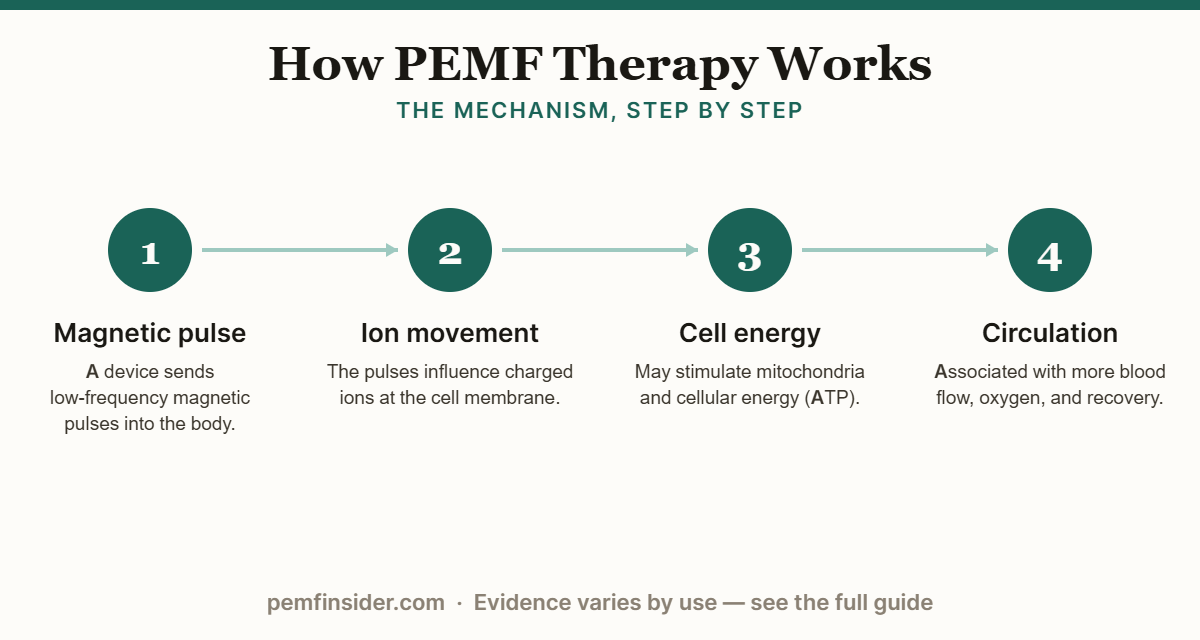
PEMF therapy works by sending pulses of low-frequency electromagnetic energy into the body, where they're thought to influence activity at the cellular level. Here's the mechanism, broken down and honestly graded, because the strength of the evidence varies from one claim to the next.
Your cells run on electricity
Every cell in your body holds a small voltage across its outer membrane. That voltage comes from the movement of charged particles, called ions, mainly sodium, potassium, and calcium, in and out of the cell. This flow of ions drives how cells signal, contract, and repair themselves. It is settled cell biology, taught in every physiology course, and it is the reason an electrical or magnetic signal can plausibly interact with living tissue at all. (Confidence: established.)
A PEMF device starts from that fact. It sends short, pulsing magnetic fields into the body. A changing magnetic field induces a small electrical current in any nearby conductive material, and your tissue, full of charged ions and water, conducts. The proposed idea is that these induced micro-currents nudge the electrical activity already happening at the cell membrane, rather than adding anything foreign to the body.
The core proposed mechanism: ion movement
The most-cited explanation for how PEMF produces an effect begins at the cell membrane. A pulsed magnetic field is thought to influence how ions, especially calcium, move across the membrane and through voltage-gated channels. A 2013 review in the Journal of Cellular and Molecular Medicine argued that low-level electromagnetic fields act largely by activating voltage-gated calcium channels, raising intracellular calcium and setting off downstream signaling Pall, Journal of Cellular and Molecular Medicine, 2013.
From there, a well-described cascade follows. Rising intracellular calcium binds to a protein called calmodulin, which in turn stimulates the release of nitric oxide, a signaling molecule that relaxes blood vessels and influences inflammation. A widely cited plastic surgery review described exactly this calcium, calmodulin, and nitric oxide pathway as the basis for PEMF's effects on healing, swelling, and blood flow Strauch et al., Aesthetic Surgery Journal, 2009. (Confidence: reasonable as a mechanism; much of the supporting work is lab and animal rather than large human trials.)
This distinction is worth stating plainly. The pathway is credible and repeatedly described in the literature, but describing a mechanism is not the same as proving a clinical result. A mechanism tells you how an effect could happen. It does not tell you how large that effect is for any given use.
Circulation and blood flow
The clearest place that mechanism shows up is circulation. If PEMF nudges the calcium and nitric oxide pathway, one expected result is vasodilation, the widening of small blood vessels, which increases local blood flow and the delivery of oxygen to tissue. The Strauch review credits PEMF with facilitating vasodilation and the formation of new small vessels, called angiogenesis Strauch et al., Aesthetic Surgery Journal, 2009.
Human data exists here too, though it is early. A double-blind, randomized study of 44 people with metabolic syndrome found that PEMF therapy increased plasma nitric oxide availability and was associated with improved blood pressure, compared with a sham group Kim et al., Blood Pressure, 2020. It is a small trial, not a definitive one, but it points in the same direction as the mechanism. For a fuller treatment of this use, see PEMF for circulation. (Confidence: reasonable for short-term, localized circulatory effects.)
Cellular energy (ATP)
A popular claim is that PEMF boosts cellular energy by increasing production of ATP, the molecule cells use as fuel. Better-energized cells, the reasoning goes, repair more efficiently. There is genuine laboratory support for the first half of that claim: a 2026 study in Scientific Reports, working with isolated rat mitochondria and cell cultures, found that PEMF stimulated the specific type of respiration linked to ATP synthesis Zavadskis et al., Scientific Reports, 2026.
The honest caveat is that this was done in isolated mitochondria and cells in a dish, not in living people. Lab-bench energy effects are a plausible starting point, not proof that lying on a home mat measurably raises your cellular energy or speeds recovery. (Confidence: plausible, preliminary; supported at the lab level, not yet demonstrated in humans.)
Inflammation
PEMF is also studied for its effect on inflammation, and the route is the same calcium, calmodulin, and nitric oxide pathway. Short bursts of nitric oxide can down-regulate pro-inflammatory messengers, and the Strauch review links PEMF to reduced post-surgical swelling through this signaling Strauch et al., Aesthetic Surgery Journal, 2009. The strongest single data point here is post-operative edema, one of the specific uses certain PEMF devices are FDA cleared for. Broader claims about chronic, whole-body inflammation are not as well supported. For more, see PEMF for inflammation. (Confidence: preliminary; strongest for localized, short-term swelling.)
Where mechanism meets a real outcome: bone healing
The place where the mechanism connects most convincingly to a measured human result is bone repair. A 2020 systematic review and meta-analysis in Bioelectromagnetics pooled 22 randomized controlled trials covering 1,468 patients and found that PEMF improved the bone-healing rate, which reached about 80 percent in PEMF groups versus 64 percent in controls, and helped relieve pain Peng et al., Bioelectromagnetics, 2020. This is why certain bone-stimulator devices carry FDA clearance for specific fracture indications. It is also the best illustration of this site's core point: the mechanism can produce a real, measurable effect in the right, well-studied use, even while broader wellness claims remain thin. (Confidence: strong for specific bone-repair indications.)
Why the effect strength varies so much
If the mechanism is real, why do results range from clearly helpful to barely noticeable? Because "PEMF" is not one dose. Three settings change what actually reaches your cells:
- Frequency (Hz). How many pulses per second. Different frequencies are thought to influence different tissues and processes, and much of the marketing around "tuned" frequencies runs well ahead of the evidence. We cover this in PEMF frequencies explained.
- Intensity (Gauss or Tesla). How strong the field is. A clinical bone stimulator and a low-intensity home mat can differ by orders of magnitude, which is one reason clinic study results do not automatically transfer to consumer devices.
- Waveform and timing. The shape of each pulse and how long you apply it change the induced current, and therefore the biological response.
Frequency and intensity are separate specifications and should never be conflated. A device can pulse at a promising frequency and still deliver too little intensity to matter, or the reverse. When you compare devices, both numbers count.
The honest summary
PEMF has a credible, well-described mechanism and a real research base. Ion movement at the cell membrane, the calcium, calmodulin, and nitric oxide cascade, improved local circulation, and lab-level energy effects fit together into a coherent story. But much of the supporting work is small, short-term, or done in the lab and in animals rather than in large human trials, and the strength of effect varies enormously by use and by device. The mechanism is sound. The size of the benefit is the part that depends on the specifics. For what the outcome research actually shows, see what the research shows, or start with what PEMF therapy is.
Frequently asked questions
Does PEMF actually do anything, or is it a placebo? The underlying mechanism is real and measurable in the lab, and for specific uses like bone repair there is randomized human evidence of a genuine effect Peng et al., Bioelectromagnetics, 2020. For many popular wellness uses, the evidence is thinner and results vary from person to person. It is fair to say the biology is credible while staying skeptical of sweeping claims.
Can you feel PEMF working? Usually not. The fields are low intensity, and most people feel little or nothing during a session. A subtle warmth or light tingling is sometimes reported, but the absence of a strong sensation does not mean nothing is happening, and a strong sensation is not a measure of effectiveness.
How is PEMF different from a TENS unit? A TENS unit sends a direct electrical current through pads on the skin, mainly to interrupt pain signals, and you feel it. PEMF uses a magnetic field to induce a much gentler current inside the tissue and targets cell-level processes rather than nerves. We compare the two in PEMF vs TENS.
Is the mechanism the same for people and animals? The underlying cell biology, ion movement, calcium signaling, and nitric oxide, is shared across mammals, which is why PEMF is studied in both. That common mechanism is also why animal and lab studies are useful clues, but a shared mechanism does not prove a specific benefit for a specific condition in either.